The latest in music tech: AI
Despite music being something that anyone with a pulse not only consumes but often takes such pleasure and pride in doing so, investing in the category has been notoriously challenging. This can be in large part attributed to the consolidation in the industry which makes investors feel like there is no place for newcomers, but it is also because dollars spent on music are challenging to extract from consumers at the moment, deflating the overall value of the industry.
Music is a drug so addictive that consumers will go to great lengths to not only obtain it but obtain it for free.
The effect that music piracy had on the industry in the early 2000s was immense, not only in the ways in which it deteriorated physical sales but in setting a precedent; a precedent that enabled consumers to ask that access to music be appallingly cheap. With over eighty million songs at less than ten dollars a month, Spotify pays artists $.005 or less per stream, on average. Music has been made to feel like a commodity, produced via the same couple of DAWs and distributed to the same few platforms. With the breadth and quality of music available at consumers’ fingertips through streaming today, why ask for more?
While music today feels like a commodity, I believe that via generative AI, there may be classes to music, leading to a de-commoditization of music that may actually propel and incentivize the consumer to pay more for what is better. In thinking about the pockets of opportunity in the music industry today, I’ll first provide a breakdown of where the value in music lies today and then point to where there may be good room for disruption and expansion.
This chart shows a breakdown of the primary revenue streams within recorded music: physical sales, streaming, downloads and digital sales, performance rights and synchronization. Evidently, the music industry has not only been disrupted but has expanded since the early 2000s. As streaming revenues cannibalized physical sales, it also created an industry-wide expansion, alongside the subtle growth of performance and synchronization revenues.
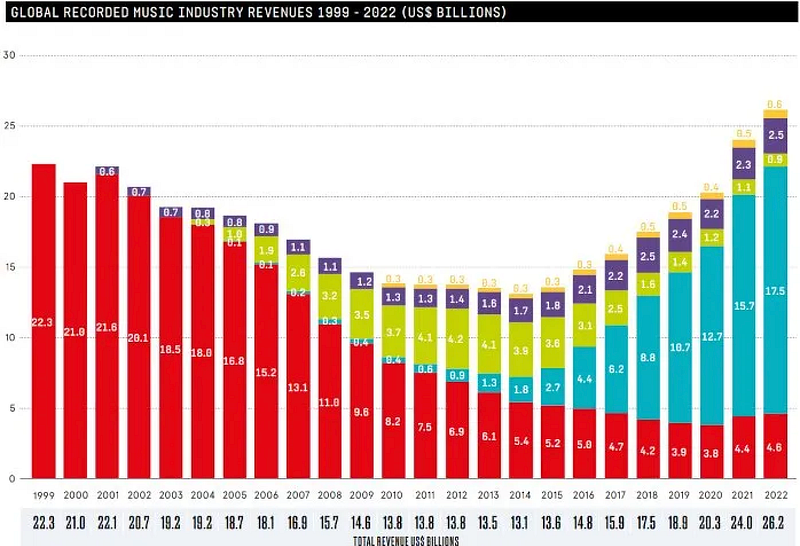
Red: Physical; Purple: Performance; Green: Downloads & Digital Sales; Yellow: Synchronization; Blue: Streaming; Source: IFPI
Within these five main categories of recorded music industry revenues, I believe that the most exciting opportunities today exist within synchronization and "other." This “other” revenue will both stealthily and dramatically impact the TAM of the music industry, bringing new consumer applications to market and bringing fans closer to the thing they love.
Starting with Sync
Last year, the conversation around innovations in music was centered around NFTs (as you can see by my latest post…), this year it is around generative AI. In my view, synchronization is the pocket of the music industry that is most likely to be directly and immediately impacted by generative AI, as stakeholders in synch seek efficiency in a market downturn.
While generative AI is an exciting category for both investment and consumption, I do believe that startups which attempt to replace the creative process in its entirety will not succeed. Though innovations within art and music will enable generative AI to grow in adoption as people enjoy their wow factors, in the long term, creative AI becomes less interesting without sufficient human gusto. I truly believe that the human experience is made meaningful through the laborious creation of the things we find beautiful. Why not begin by tackling areas of monotony within our creative processes, allowing more time for us to create? Synch is a great place to start.
While synch royalties are typically more lucrative at the start given their upfront fee plus ongoing royalty structure, they require negotiation, as opposed to mechanical royalties (rates determined by law) and performance royalties (rates determined by PROs). Given the inefficiencies involved, there is room for generative AI in particular to provide a new source of music for use in synch licensing.
AI can be used to generate original compositions that are tailored to specific types of visual content, such as background music for advertisements or theme music for TV shows. Now, supervisors can be involved in a level of creation as opposed to only curation, enhancing their creative outlook and avoiding inefficiencies. I should note that as music generated by AI is currently of lower quality and secondary to traditionally-produced tracks, I’d recommend this as a way to enhance visual media in the short term, as music is not necessarily the primary focus of the content when used in synch applications.
Companies worth tracking in the space:
Other: New Consumer Applications
I believe that the mass market is ripe for one or a couple of music-focused consumer applications in the following categories: music investing and music production. As only a handful of private equity firms and major labels control the most valuable music rights in the world via catalog, it is time for fans to access this financial upside (albeit ~5% ROI).
Those who are less financially literate, who may not be savvy enough to trade traditional equities, in addition to those who want to express conviction in their music taste, can trade catalog. With fans having “skin in the game,” they are more likely to enable revenue opportunities for artists in other categories. In addition, the data around these investment decisions can of course lead to better targeting and overall music industry revenue expansion.
Further, music production and creation apps, especially now through AI (primarily via Riffusion and Harmonai’s Dance Diffusion models), will enable the consumer to engage with music in new ways. As these applications will likely be monetized on a sub $10/mo subscription basis, this feels like a winner-take-all market. Only once one or a couple of these apps reach mass adoption will meaningful revenue be added to the industry.
Companies worth tracking in the space:
Music Investing
Music Creation
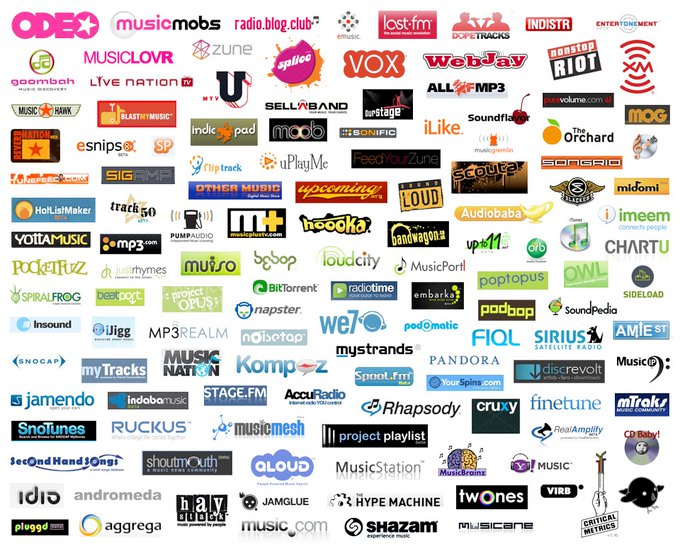
The image below is just a friendly reminder of how the music streaming landscape looked in the mid 2000s. With that, I’ll end here by saying that I’m just really excited to see how the music technology ecosystem progresses and where the value accrues.
Last but not least, if you are building in the space, don’t hesitate to send me a message on LinkedIn or find me in Nashville at Music Biz next week. Cheers, and here’s a fun song to draft me a note to.
https://open.spotify.com/track/0hNlr56UPvigGSyCVdAOMi?si=3c22424e0d914019
:)
Note that all opinions here are my own and do not necessarily reflect the opinions of any organization that I am affiliated with.